Trending...
- Registered Nurse Launches Healthcare Wealth Strategy Practice for Healthcare Professionals - 302
- Denver Apartment Finders Updates Its RiNo Page to Help Renters Navigate Denver's River North Market
- Backed By Google And Nvidia, Imagiportal Supercharges Ai Personas With 10,000+ Elevenlabs Voices
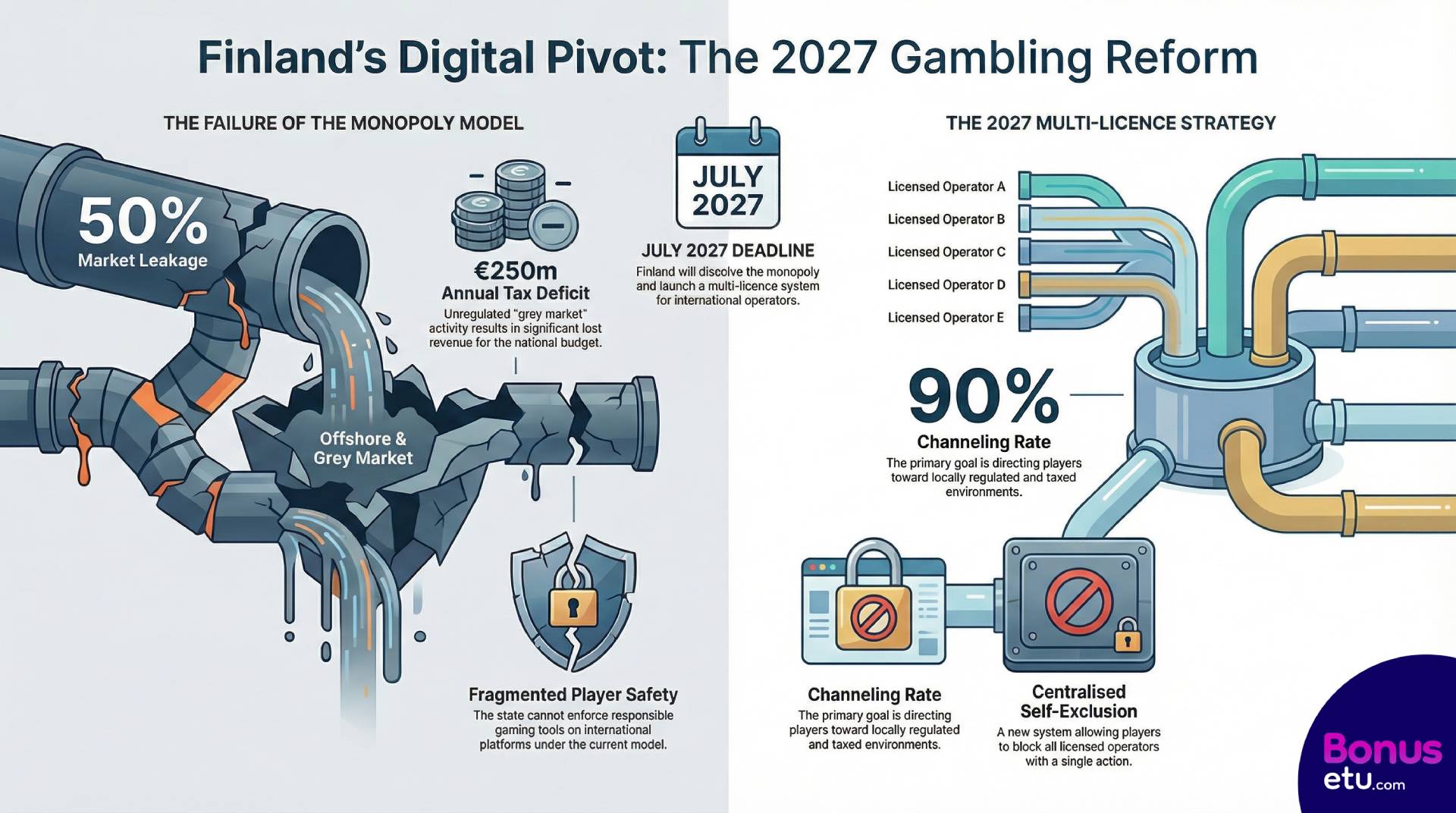

Bonusetu examines the strategic pivot in Helsinki's gambling policy, as the Finnish government moves to dissolve its long-standing monopoly by July 1, 2027. This decision is a response to a documented failure of the "restriction-based" model.
According to the government's official assessment in HaVM 28/2025 vp, the current system has reached a breaking point, with roughly half of the nation's digital gambling volume occurring outside the domestic regulatory umbrella.
According to the government's official assessment in HaVM 28/2025 vp, the current system has reached a breaking point, with roughly half of the nation's digital gambling volume occurring outside the domestic regulatory umbrella.
HELSINKI - ColoradoDesk -- The primary catalyst for this historic reform is the rapid decline of the state monopoly's digital market share. Bonusetu market data reinforces the government's admission: as consumers migrated to mobile and high-speed web platforms, the state-owned provider could no longer compete with the efficiency and variety offered by international online casinos.
The government's move toward a multi-license system acknowledges that the demand for diverse gaming products has outgrown the current monopoly. To understand the scale of this demand, one can examine the current market landscape of https://bonusetu.com/kaikki-nettikasinot/ ('all online casinos'), which includes hundreds of international operators catering to Finnish players.
"This statistic is a definitive reality check," explains Tommi Korhonen, CEO of Bonusetu. "Finnish players have been utilizing their digital freedom to access global platforms for years. By 2024, nearly 50% of the €1.3 billion digital market had already migrated to offshore entities. The government faced a binary choice: continue to lose hundreds of millions in tax revenue or implement a multi-license system that captures this existing demand."
More on Colorado Desk
From "Restriction" to the "Channeling" Strategy
The 2027 Gambling Reform introduces a fundamental shift in the state's role, moving from a strategy of total restriction to one of active channeling. The "Channeling Rate" is now the primary metric of success for the Ministry of the Interior. The goal is to direct at least 90% of Finnish players toward a locally licensed environment by offering a competitive market with a transparent 22% tax rate.
This transition acknowledges that digital borders are porous. Rather than attempting to block access—a tactic that has proven technically and legally insufficient—the state will now license international operators who agree to comply with Finnish laws regarding Anti-Money Laundering (AML) and consumer protection.
The Social and Regulatory Cost of Inaction
One of the most compelling arguments for legalization is the restoration of player safety. Under the monopoly system, the Finnish state could not protect citizens who encountered issues on unlicensed international platforms. The absence of a centralized oversight mechanism meant that responsible gaming tools were fragmented and inconsistent.
The new legislation introduces a centralized self-exclusion register (keskitetty pelinestojärjestelmä), a tool that was previously impossible to implement across competing offshore brands. Once the reform is fully enacted, a player can self-exclude from every licensed operator in Finland with a single action. This infrastructure allows the state to fulfill its duty of care in a way that the isolationist monopoly model never could.
More on Colorado Desk
The Economic Impact: Recovering Lost Revenue
Beyond safety, the economic implications of the reform are substantial. Bonusetu analysts estimate that the "grey market" leakage resulted in an annual tax deficit of approximately €150 million to €250 million. By legalizing and licensing the market, these funds will be redirected back into the Finnish national budget, specifically earmarked for the prevention of gambling-related harm and the support of cultural initiatives.
"This is not about encouraging more gambling," says Tommi Korhonen. "It is about the state taking responsibility for the activity that is already happening. The monopoly worked for physical machines in the 1990s, but it was unable to survive the transparency and speed of the modern internet. Legalization provides the state with the tools to tax, regulate, and protect."
About Bonusetu.com Established in 2016, Bonusetu.com is a leading market intelligence platform for the Nordic iGaming sector. We specialize in analyzing regulatory frameworks, software integrity, and payment technologies to provide Finnish consumers and stakeholders with transparent, actionable data.
LinkedIn: https://www.linkedin.com/company/bonusetu/
X (Twitter): https://x.com/bonusetu_com
GBP: https://share.google/S1obwB4k7CxotcSBo
The government's move toward a multi-license system acknowledges that the demand for diverse gaming products has outgrown the current monopoly. To understand the scale of this demand, one can examine the current market landscape of https://bonusetu.com/kaikki-nettikasinot/ ('all online casinos'), which includes hundreds of international operators catering to Finnish players.
"This statistic is a definitive reality check," explains Tommi Korhonen, CEO of Bonusetu. "Finnish players have been utilizing their digital freedom to access global platforms for years. By 2024, nearly 50% of the €1.3 billion digital market had already migrated to offshore entities. The government faced a binary choice: continue to lose hundreds of millions in tax revenue or implement a multi-license system that captures this existing demand."
More on Colorado Desk
- Governor Polis and Colorado Parks and Wildlife announce first investments from SB24-230 for Wildlife and Land Protection Funds
- Rhealize Strategic Talent Advisory Co-Founder Dona Baker to Speak at DisruptHR YEG 15.0 in Edmonton on Hiring Innovation
- Instant IP Teams: Bringing Enterprise-Grade Collaboration to IP Protection at the Speed of Thought
- UK Financial Ltd Confirms CATEX Exchange Integration of SMPRA and LTNS 1 Ahead of Compliance-Based Trading Activation
- Colorado: Governor Polis Signs Bills Law
From "Restriction" to the "Channeling" Strategy
The 2027 Gambling Reform introduces a fundamental shift in the state's role, moving from a strategy of total restriction to one of active channeling. The "Channeling Rate" is now the primary metric of success for the Ministry of the Interior. The goal is to direct at least 90% of Finnish players toward a locally licensed environment by offering a competitive market with a transparent 22% tax rate.
This transition acknowledges that digital borders are porous. Rather than attempting to block access—a tactic that has proven technically and legally insufficient—the state will now license international operators who agree to comply with Finnish laws regarding Anti-Money Laundering (AML) and consumer protection.
The Social and Regulatory Cost of Inaction
One of the most compelling arguments for legalization is the restoration of player safety. Under the monopoly system, the Finnish state could not protect citizens who encountered issues on unlicensed international platforms. The absence of a centralized oversight mechanism meant that responsible gaming tools were fragmented and inconsistent.
The new legislation introduces a centralized self-exclusion register (keskitetty pelinestojärjestelmä), a tool that was previously impossible to implement across competing offshore brands. Once the reform is fully enacted, a player can self-exclude from every licensed operator in Finland with a single action. This infrastructure allows the state to fulfill its duty of care in a way that the isolationist monopoly model never could.
More on Colorado Desk
- Colorado: Governor Polis Makes Cabinet Announcement
- Ashikaga Flower Park's "Great Wisteria Festival 2026"
- Architect of Neurodiversity Will Lead the First U.S. Team of Autistic Children to the "Genius Cup" in Hiroshima, Japan, in 2027
- Deborah E. Jones Introduces Emotional Sovereignty, a Powerful New Book on Emotional Mastery, Resilience, and Intentional Living
- New Research Identifies "The Busy Effect": 89% of Americans Want a Laid-Back Vacation — Only 15% Actually Achieve It
The Economic Impact: Recovering Lost Revenue
Beyond safety, the economic implications of the reform are substantial. Bonusetu analysts estimate that the "grey market" leakage resulted in an annual tax deficit of approximately €150 million to €250 million. By legalizing and licensing the market, these funds will be redirected back into the Finnish national budget, specifically earmarked for the prevention of gambling-related harm and the support of cultural initiatives.
"This is not about encouraging more gambling," says Tommi Korhonen. "It is about the state taking responsibility for the activity that is already happening. The monopoly worked for physical machines in the 1990s, but it was unable to survive the transparency and speed of the modern internet. Legalization provides the state with the tools to tax, regulate, and protect."
About Bonusetu.com Established in 2016, Bonusetu.com is a leading market intelligence platform for the Nordic iGaming sector. We specialize in analyzing regulatory frameworks, software integrity, and payment technologies to provide Finnish consumers and stakeholders with transparent, actionable data.
LinkedIn: https://www.linkedin.com/company/bonusetu/
X (Twitter): https://x.com/bonusetu_com
GBP: https://share.google/S1obwB4k7CxotcSBo
Source: Bonusetu.com
Filed Under: Business, Government
0 Comments
Latest on Colorado Desk
- Century Fasteners Corp. Exhibiting at 2026 MRO Americas Show – April 21-23, 2026 – Booth #2257
- Colorado Announces Proposal to Annex Northern New Mexico, Protecting State From Texas Aggression
- Blue Sparrow Coffee named Best Matcha in Westword's Best of Denver 2026
- Ocean County College Introduces Pathways to Simplify the Student Journey and Strengthen Career Connections
- Kiko Nation Expands to Apple App Store, Achieving Full Mobile Deployment for Livestock Digital Registry Platform
- The Lawyers' Marketer Launches Claude AI Implementation Service for Law Firms
- Certified Trading Card Association and Collectors MD Launch Healthy Hobby Initiative
- Colorado Springs: The next wildfire is coming. Be Ready. Set. Go
- Colorado: Governor Polis Meets with Small Businesses to Discuss Impacts of Federal Tariffs and State Support Efforts
- L2 Aviation Earns FAA STC for Thales AVIATOR 200S for Boeing 777
- Colorado: Governor Polis, State Forest Service Announce $8.5 Million in Wildfire Mitigation Grants
- Colorado: New Electronics Manufacturing Business Comes to Alamosa County with Support from Rural Jump-Start Program
- FinIQ Edu Launches High-Impact Workshop Vertical to Close the Workplace Benefits Gap—Drives 82% Surge in 401(k) Participation Intent
- Colorado: Governor Polis Signs Law to Rename Cesar Chavez Day to Farm Worker Day
- HousingWire launches Mortgage Rankings, bringing a data-driven benchmark to originator performance
- J&J Exterminating Reminds Residents to prepare for Termite Swarm Season
- Colorado: Supreme Court Restricts States' Ability to Protect LGBTQ Youth From Inhumane Conversion Therapy
- Bibamba Artisan Chocolate Named "Best Chocolatier" by Westword in Best of Denver 2026
- Registered Nurse Launches Healthcare Wealth Strategy Practice for Healthcare Professionals
- Just 1 in 57 Crypto Owners Globally Pay Taxes on Their Holdings, New Report Finds